Mbe
Mbe is the Company’s flagship project within the district-scale Eastern Central Licence Package (Eastern CLP) in central Cameroon. It is underlain by ~312km2 of previously unexplored Paleo-Proterozoic to Pan-African age rocks that are highly prospective for a range of commodities, including orogenic-style gold mineralisation. The Eastern CLP is located to the west of the regional capital, Ngaoundéré, and Mbe is one of five licences that make up the block.
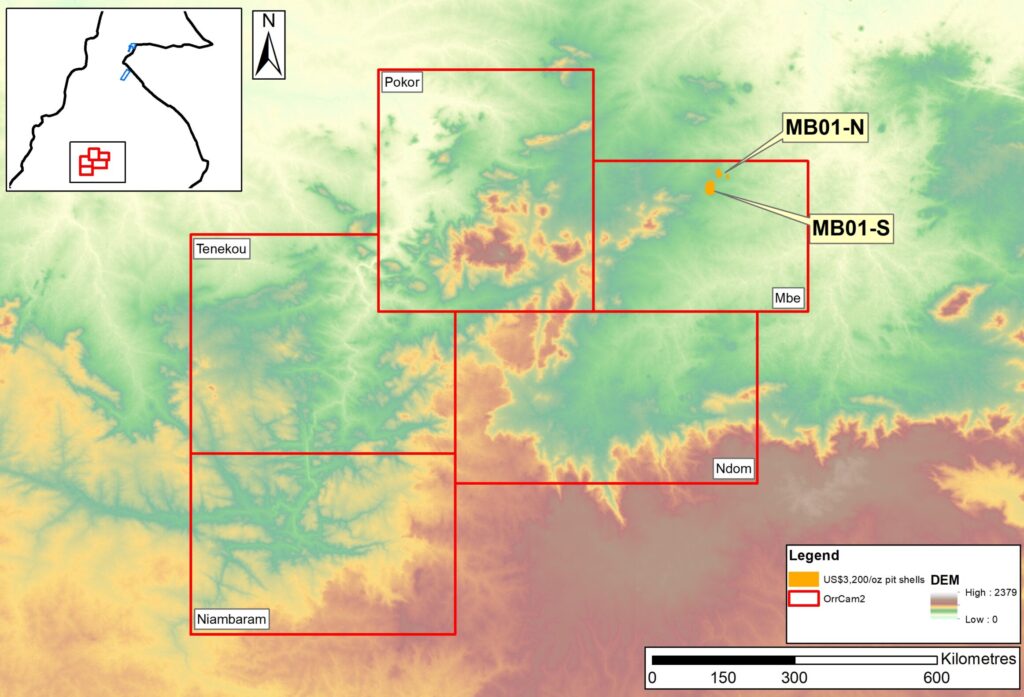
Oriole has a 50% interest in the project, with its partner BCM International holding the remaining 50% interest. Oriole remains technical operator and funding is on a contribute or dilute basis.
Mineral Resource Estimate at MBE
Independent consultant Forge International Limited has completed Mineral Resource Estimates (MREs) for both MB01-S and MB01-N, the two sub-prospects that make up the MB01 prospect, which are lie approximately 700m apart. The models are based on geological and assay data from the 2024 trenching programme and 9,305.20m of diamond drilling in 34 holes (MBDD001 to MBDD024, MBDD040 to MBDD049) at MB01-S, and 2,982.80m of diamond drilling in 15 holes (MBDD025 – MBDD039) at MB01-N.
As of July 2026, the total Inferred Resource at MB01 stands at 1.66 million oz contained Au, using a 0.40g/t Au cut-off grade and a US$3,200/oz gold price.
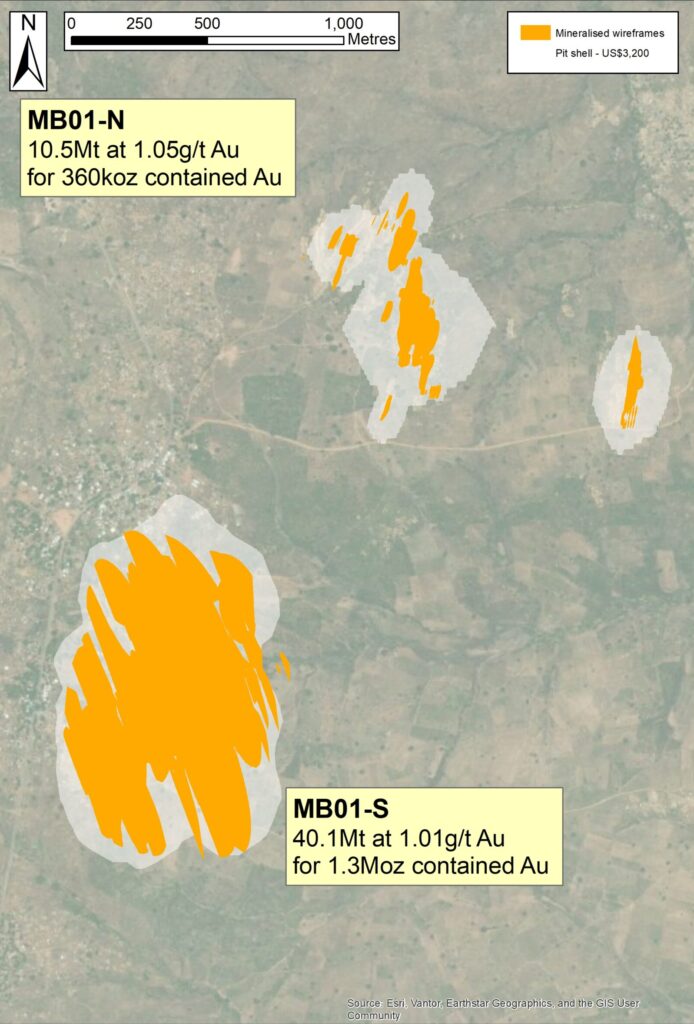
The MRE for MB01-S was updated in July 2026 and stands at 40.1Mt with an average grade of 1.01g/t Au for 1,300,000oz contained gold within the JORC Inferred category, using a 0.40g/t Au lower cut-off grade and within a US$3,200/oz gold price open pit shell. The MRE extends over a strike length of approximately 1,200m, a width of approximately 730m, and to a depth of approximately 287m. Mineralisation remains open laterally and at depth.
The MRE for MB01-N was published in April 2026 and stands as 10.5Mt with an average grade of 1.05g/t Au for 360,000oz contained gold within the JORC Inferred category, using a 0.40g/t Au lower cut-off grade and within a US$3,200/oz gold price open pit shell. The MRE extends over a strike length of approximately 720m, a width of up to 125m, and a maximum vertical depth of 270m. Mineralisation remains open laterally and at depth.
| Gross | Net (50%) | |||||||
| JORC Classification | Oxidation Level | Tonnage (t) | Grade (g/t Au) | Total Contained gold (oz) | Tonnage (t) | Grade (g/t Au) | Total Contained gold (oz) | |
| MB01-S | Inferred | Oxide | 6,400,000 | 0.87 | 180,000 | 3,200,000 | 0.87 | 90,000 |
| Inferred | Fresh | 33,700,000 | 1.04 | 1,120,000 | 16,850,000 | 1.04 | 560,000 | |
| Total | 40,100,000 | 1.01 | 1,300,000 | 20,050,000 | 1.01 | 650,000 | ||
| MB01-N | Inferred | Oxide | 800,000 | 0.75 | 20,000 | 400,000 | 0.75 | 10,000 |
| Inferred | Fresh | 9,700,000 | 1.07 | 340,000 | 485,000 | 1.07 | 170,000 | |
| Total | 10,500,000 | 1.05 | 360,000 | 5,250,000 | 1.05 | 180,000 | ||
| MB01 | Combined total | 1,660,000 | 830,000 |
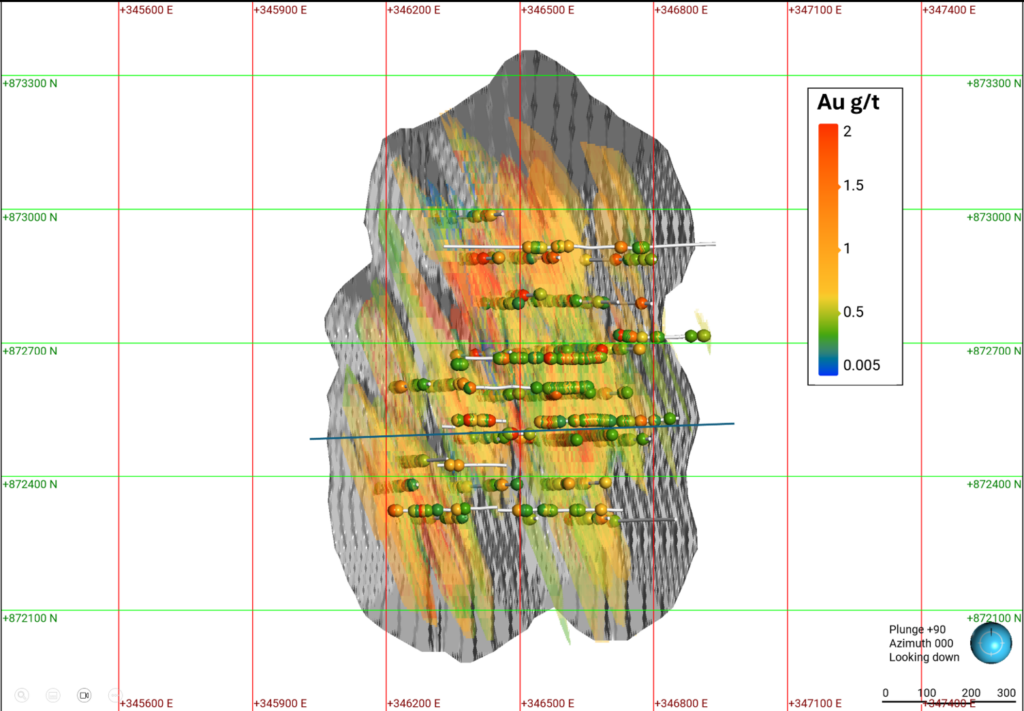
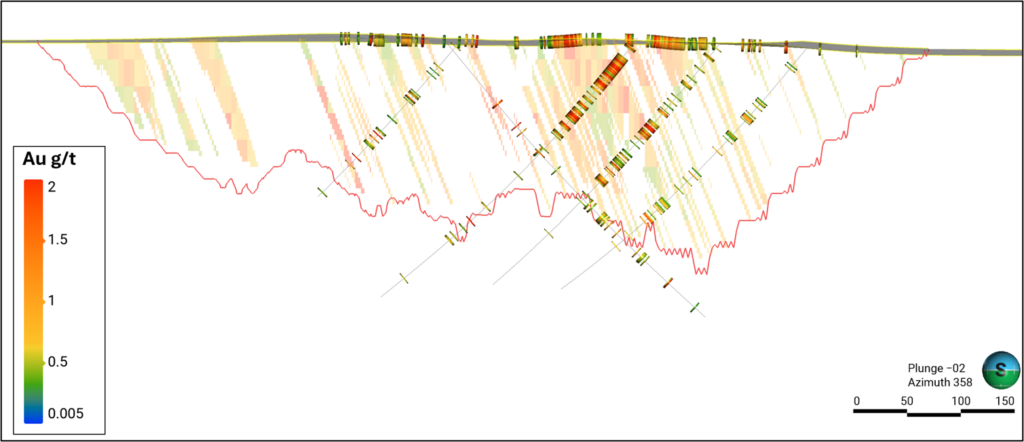


At MB01-S, grade tonnage sensitivity analysis demonstrates the robustness of the MRE across a range of cut-off grades between 0.30g/t Au and 0.55g/t Au, with contained metal content showing modest variation and highlighting that the deposit is not overly sensitive to cut-off grade selection.
| Cut off grade (Au ppm) | Tonnes (t) | Grade Au (ppm) | Contained metal (Au troy oz) |
| 0.50 | 35,300,000 | 1.09 | 1,240,000 |
| 0.45 | 38,200,000 | 1.04 | 1,280,000 |
| 0.40 | 40,100,000 | 1.01 | 1,300,000 |
| 0.35 | 41,500,000 | 0.99 | 1,320,000 |
| 0.30 | 42,400,000 | 0.98 | 1,330,000 |
Similarly, grade tonnage sensitivity analysis of MB01-N demonstrates that the deposit it not particularly sensitive to cut-off grade selection (based on a range of cut-off grades from 0.20 to 0.60g/t Au).
| Cut-off Grade (Au g/t) | Tonnes (t) | Grade (g/t Au) | Contained Metal (Au troy oz) |
| 0.60 | 9,100,000 | 1.13 | 330,000 |
| 0.50 | 10,100,000 | 1.07 | 350,000 |
| 0.40 | 10,600,000 | 1.05 | 360,000 |
| 0.30 | 10,700,000 | 1.04 | 360,000 |
| 0.20 | 11,000,000 | 1.02 | 260,000 |
Results from initial metallurgical analysis of 18 representative pit samples suggest that the near-surface, oxidised material, was amenable to conventional leaching extraction methods. More detailed metallurgical testwork studies on drill core samples from within the fresh ore zone (MBDD002), has confirmed that the gold predominantly occurs as fine-grained tellurides, similar to that identified at the Company’s Bibemi gold project. Further testwork will inform the optimal processing route from the various options available.
Diamond drilling
MB01-S
Two drilling phases have been completed at MB01-S. Phase 1 drilling was completed in September 2025 for 6,828.40m in twenty four holes (MBDD001 – MBDD024), and Phase 3 drilling completed in June 2026 for 2,476.80m in ten holes (MBDD040 – MBDD049), totalling 9,305.20m in 34 holes across both phases.
The most significant intersections returned to date from MB01-S are 86.50m at 1.36g/t Au from 22.00m including 39.40m at 2.00g/t Au, 6.00m at 2.24g/t Au, and 3.00m at 2.32g/t Au (MBDD008), 6.15m at 19.67g/t Au from 118.65m including 1.00m at 119.10g/t Au (MBDD019), 1.00m at 59.00g/t Au (MBDD041) and 27.20m at 1.69g/t Au (MBDD044). Multiple other holes have returned broader envelopes of lower grade material with narrower zones of higher grade (>1g/t Au) gold mineralisation, as observed in the trenching programme. The best intersections (>5 g*m) are presented in the table below.
The results confirm significant near-surface mineralisation related to strong silicification. Mineralisation is typically structurally controlled as sulphide-telluride veins/veinlets infilling conjugate brittle fracture sets. The brittle fractures occur within the orthogneiss host rock and felsic intrusive dykes of granitic composition, and can be locally enhanced within the felsic units. The results continue to demonstrate narrow high gold grading zones within wider, lower gold grade, bulk-tonnage, from near surface, which could be open pit mineable.
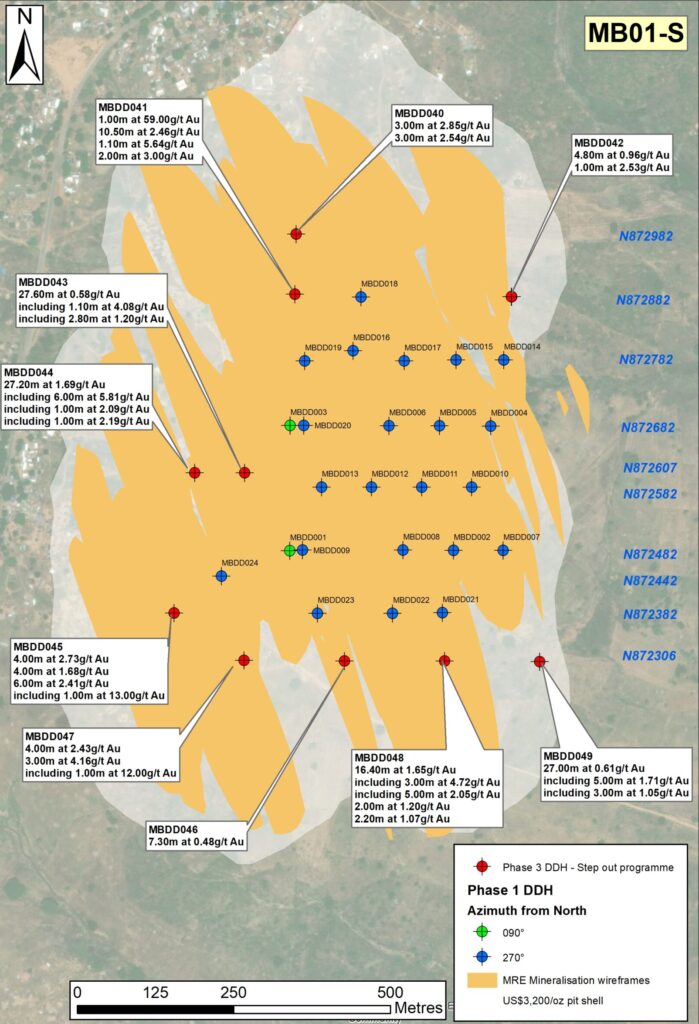
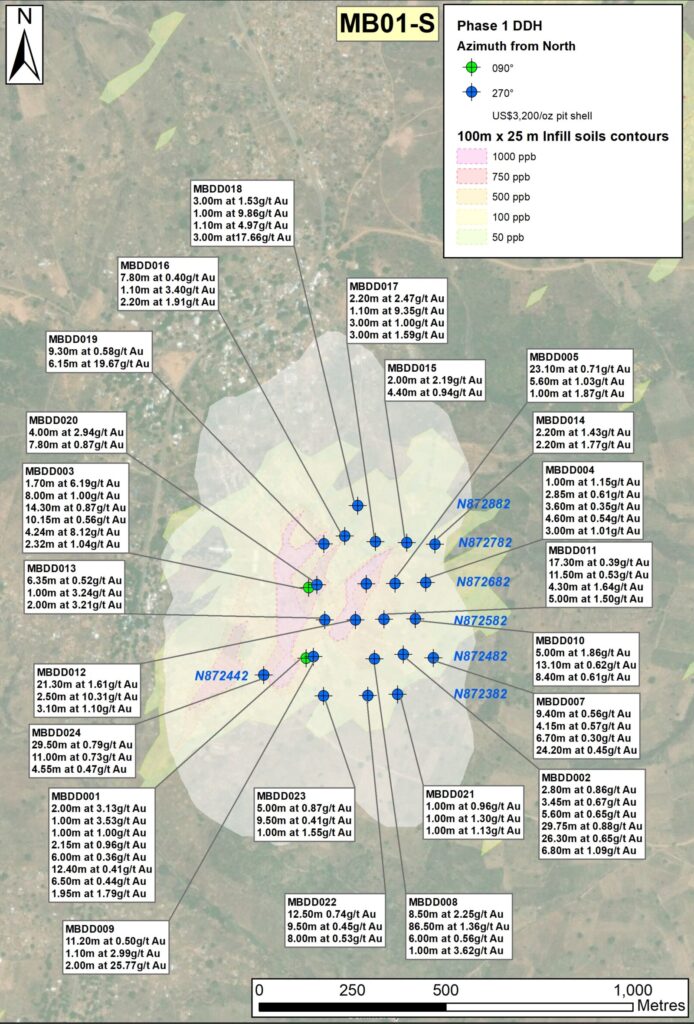


Table of best intersections (>5g*m) from MB01-S drilling to date
| DH ID | Interval Length (m) | Au grade (g/t) | g*m |
| MBDD019 | 6.15 | 19.67 | 120.97 |
| MBDD008 | 86.50 | 1.36 | 117.64 |
| MBDD041 | 1.00 | 59.00 | 59.00 |
| MBDD018 | 3.00 | 17.66 | 52.98 |
| MBDD009 | 2.00 | 25.77 | 51.54 |
| MBDD044 | 27.20 | 1.69 | 45.97 |
| MBDD003 | 4.24 | 8.12 | 34.43 |
| MBDD012 | 21.30 | 1.61 | 34.29 |
| MBDD048 | 16.40 | 1.65 | 27.06 |
| MBDD002 | 29.75 | 0.88 | 26.18 |
| MBDD041 | 10.50 | 2.46 | 25.83 |
| MBDD012 | 2.50 | 10.31 | 25.78 |
| MBDD024 | 29.50 | 0.79 | 23.31 |
| MBDD002 | 26.30 | 0.65 | 17.10 |
| MBDD049 | 27.00 | 0.61 | 16.47 |
| MBDD005 | 23.10 | 0.71 | 16.40 |
| MBDD043 | 27.60 | 0.58 | 16.01 |
| MBDD045 | 6.00 | 2.41 | 14.46 |
| MBDD047 | 3.00 | 4.16 | 12.48 |
| MBDD003 | 14.30 | 0.87 | 12.44 |
| MBDD020 | 4.00 | 2.94 | 11.76 |
| MBDD045 | 4.00 | 2.73 | 10.92 |
| MBDD007 | 24.20 | 0.45 | 10.89 |
| MBDD017 | 1.10 | 9.35 | 10.29 |
| MBDD018 | 1.00 | 9.86 | 9.86 |
| MBDD047 | 4.00 | 1.68 | 9.72 |
| MBDD023 | 12.50 | 0.74 | 9.25 |
| MBDD040 | 3.00 | 2.82 | 8.46 |
| MBDD006 | 13.80 | 0.61 | 8.42 |
| MBDD010 | 13.10 | 0.62 | 8.12 |
| MBDD024 | 11.00 | 0.73 | 8.03 |
| MBDD040 | 3.00 | 2.54 | 7.62 |
| MBDD011 | 5.00 | 1.50 | 7.50 |
| MBDD045 | 4.00 | 1.68 | 6.72 |
| MBDD011 | 17.30 | 0.38 | 6.57 |
| MBDD041 | 1.10 | 5.64 | 6.20 |
| MBDD011 | 11.50 | 0.53 | 6.10 |
| MBDD040 | 2.00 | 3.00 | 6.00 |
| MBDD047 | 1.00 | 5.37 | 5.37 |
| MBDD001 | 12.40 | 0.41 | 5.08 |
MB01-N
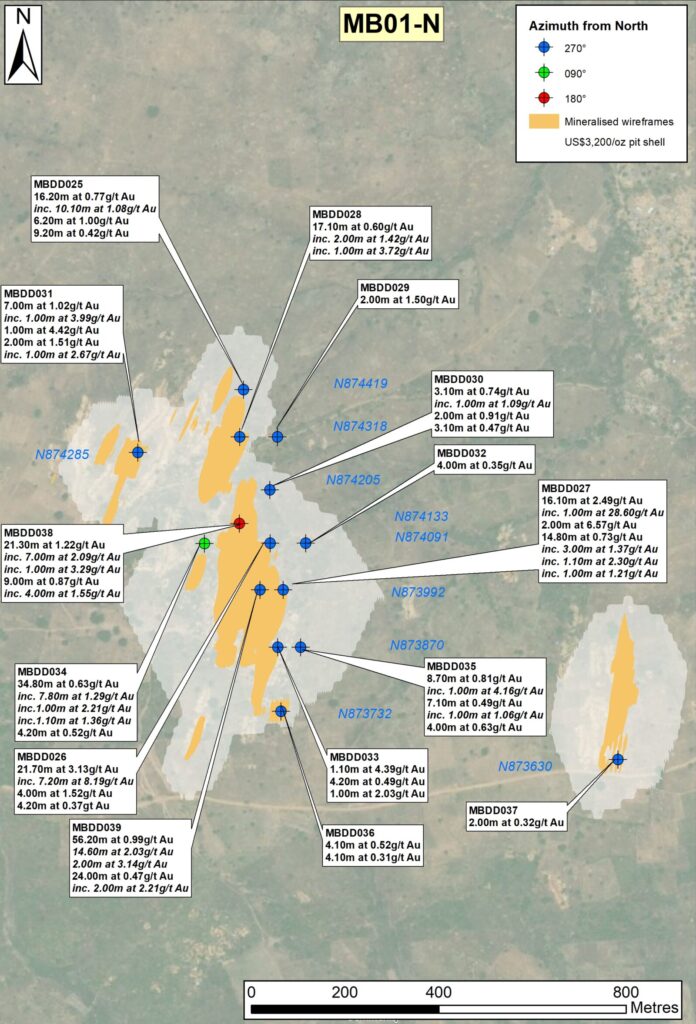
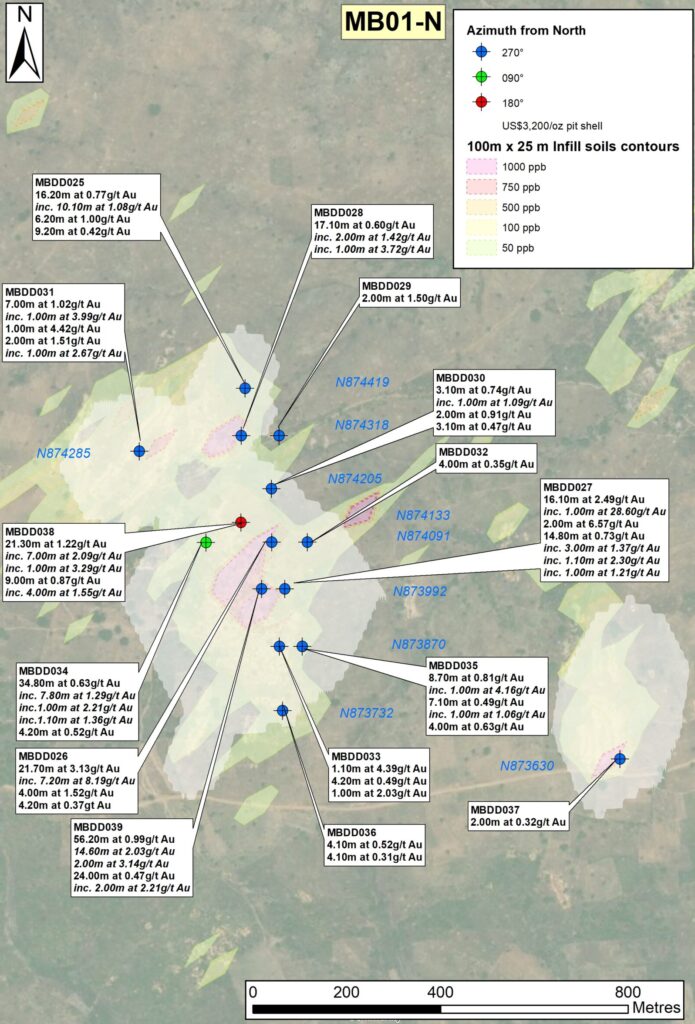
A Phase 2 drilling programme, targeting MB01-N was initiated in November 2025 and completed in February 2026 for 2,982.80m in 15 holes. The programme was predominantly drilled to the west (270˚), with two exceptions MBDD034 and MBDD028. MBDD034 was drilled as a scissor hole (drilling azimuth of 090˚ – east) on fence line N874091 to investigate the key structures controlling mineralisation in MBDD026 and MBDD032. MBDD038 was drilled towards the south (180˚) to investigate E-W trending mineralised veins observed in MBDD034, MBDD032 and MBDD026.
Results have been received for the programme with best results of 21.70m at 3.13g/t Au including 7.20m at 8.19g/t Au from MBDD026, 56.20m at 0.99g/t Au including 14.60m at 2.03g/t Au and 24.00m at 0.37g/t Au including 2.00m at 2.21g/t Au in MBDD039, 16.10m at 2.49g/t Au including 1.00m at 28.60g/t Au, 2.00m at 6.57g/t Au and 14.80m at 0.73g/t Au from MBDD027, 21.30m at 1.22g/t Au including 7.00m at 2.09g/t Au from MBDD038 34.80m at 0.63g/t Au including 7.80m at 1.29g/t Au from MBDD034, 16.20m at 0.77g/t Au including 10.10m at 1.08g/t Au from MBDD025 and 17.10m at 0.60g/t Au from MBDD028.
The geology at MB01-N is shares many similarities with MB01-S. The dominant lithologies comprise orthogneiss-amphibolite basement, intruded by numerous shear-hosted granitic felsic dykes and late mafic dykes. The system is confirmed to at least 300m wide, 700m long, and 194m vertical depth, and remains open laterally and at depth.
The mineralisation is predominantly structurally controlled by post felsic intrusion, shear-related extension and brittle failure that has formed conjugate fracture sets and NNW-trending zones of brecciation, subsequently exploited by gold-rich hydrothermal fluids. The mineralisation typically occurs within steeply dipping shear corridors, with mineralisation enhanced by brittle failure of the felsic intrusions. An E-W component to the mineralisation is also observed at MB01-N, which was investigated in MBDD038 and is interpreted to occur within the mineralised corridor locally contributing to higher gold grades.