CLP – Other
The Eastern CLP is a district-scale land package in central Cameroon, covering 2,266km2 of previously unexplored Paleo-Proterozoic to Pan-African age rocks that are highly prospective for a range of commodities, including orogenic-style gold mineralisation and lithium.
Located to the west of the regional capital, Ngaoundéré, the Eastern CLP comprises five licences (Tenekou, Niambaram, Pokor, Ndom and Mbe) prospective for gold; Oriole has 90% ownership of four of the licences, the exception being Mbe, where BCM International has earned 50% ownership. A further licence, Maboum, is currently under application to the east of the Eastern CLP.
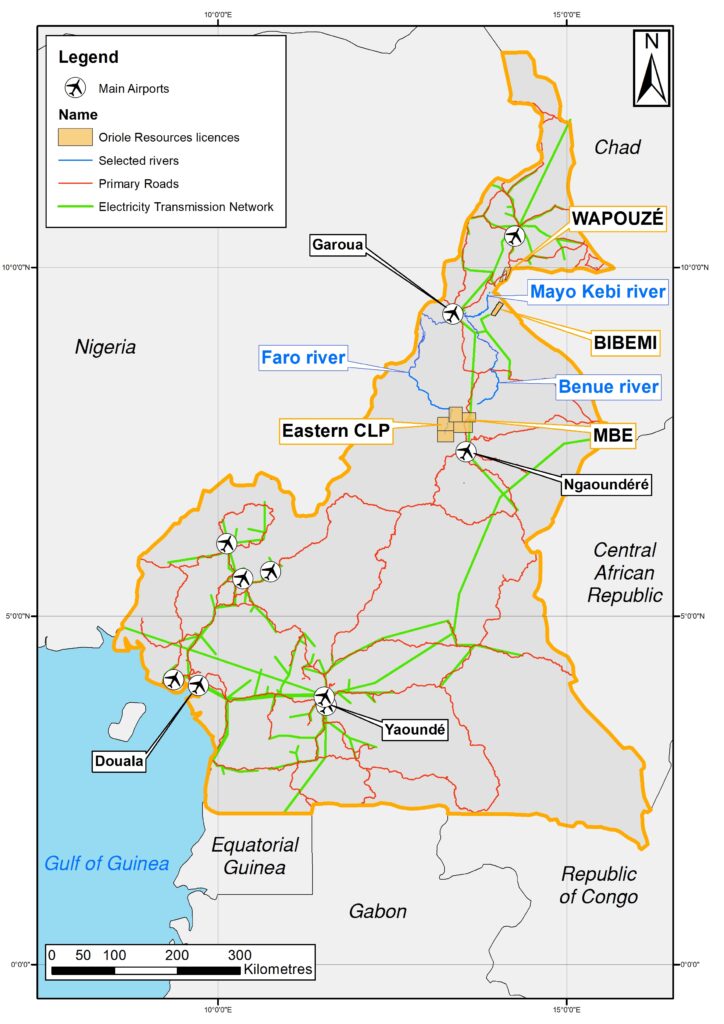
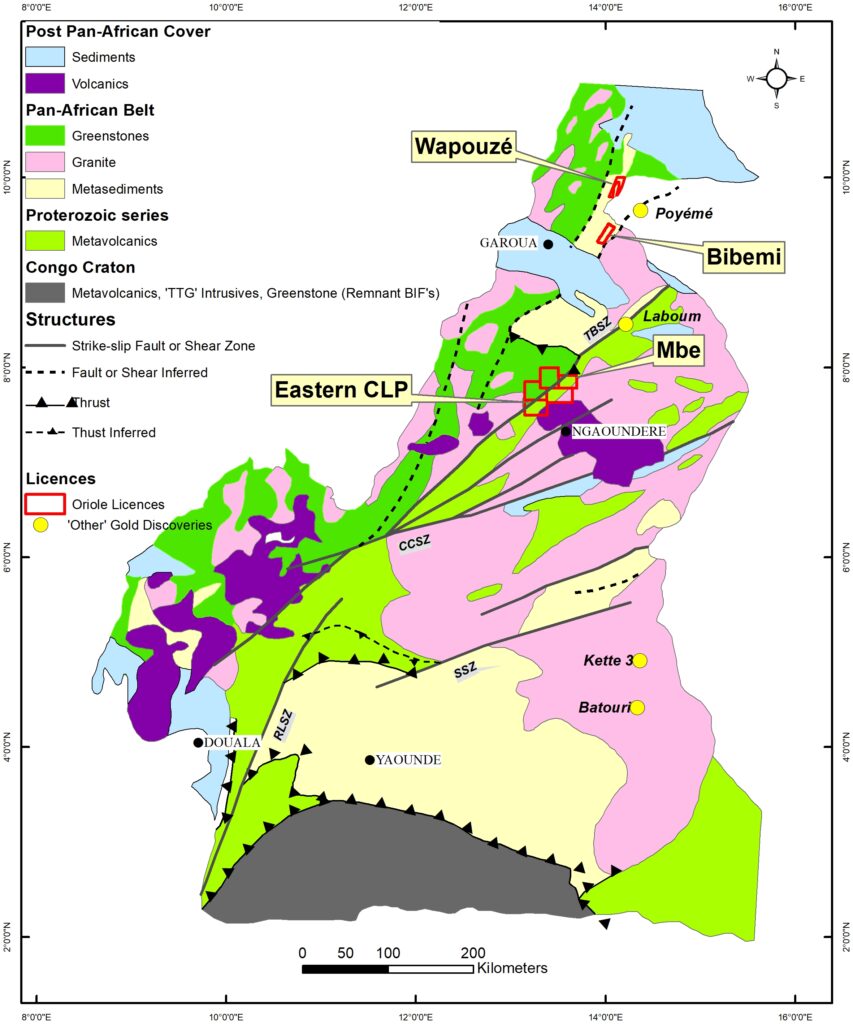
The Eastern CLP licences, all of which were granted in February 2021, were applied for following an in-house, country-wide prospectivity analysis that deemed the district as having significant potential to host orogenic-type gold mineralisation. This assessment was made on the basis of host-rock geology, structural location – targeting the regional Tcholliré-Banyo shear zone (TBSZ) which is a major splay off the larger scale Central African Shear Zone. The TBSZ and its associated shears, thrusts and faults are (according to academic literature) thought to be one of the significant structural controls for gold and other mineralisation in the region. Remote sensing work interpreted that the TBSZ passes through all of the Eastern CLP licences.
Eastern CLP – REgional scale Gold exploration
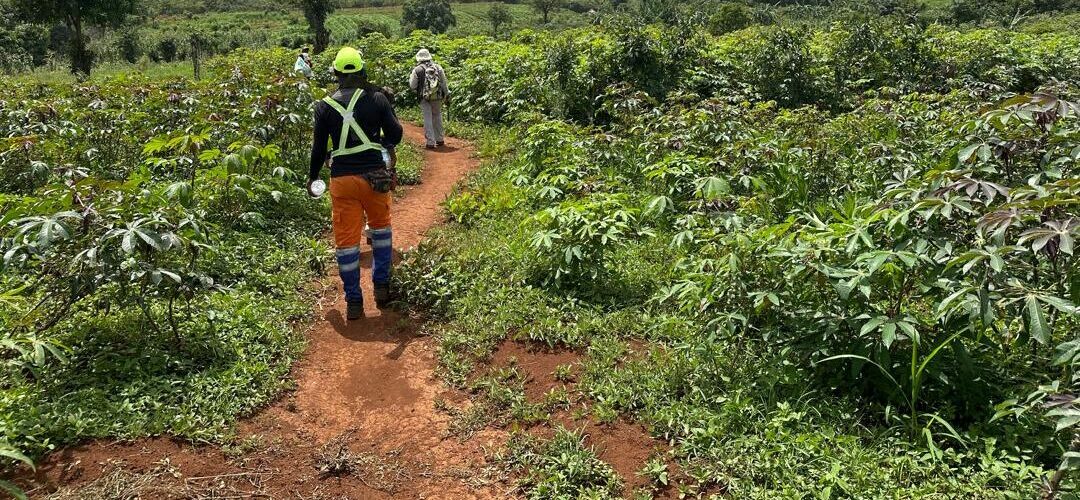
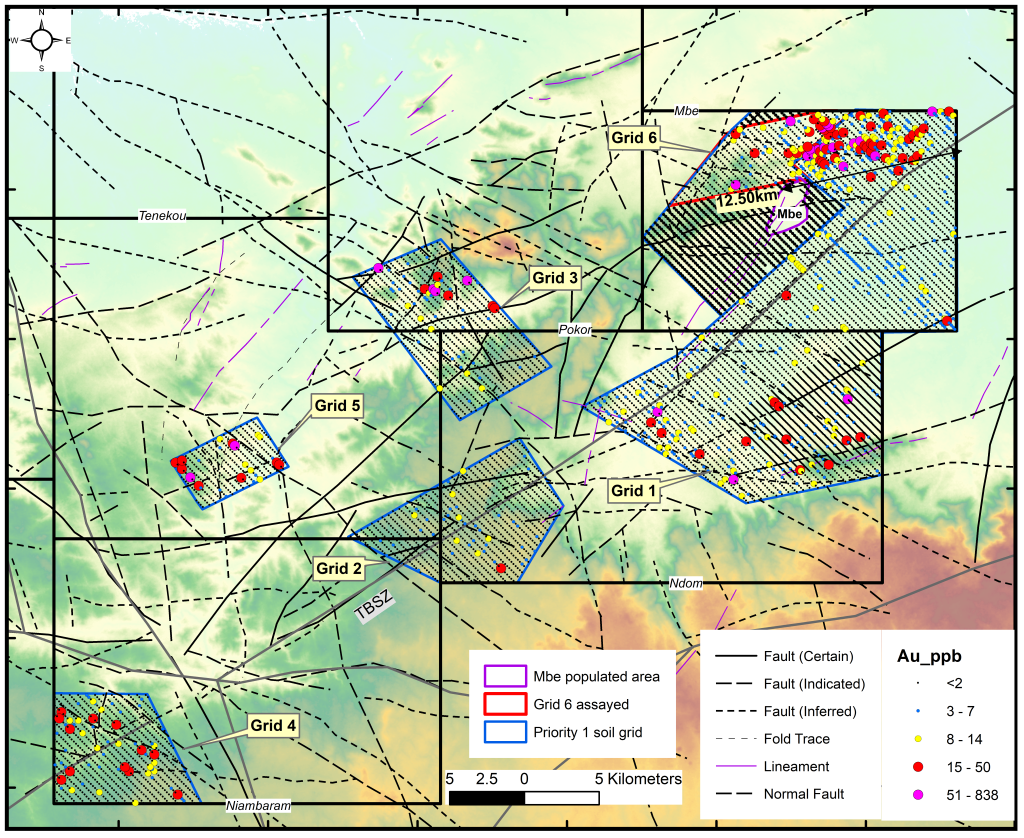
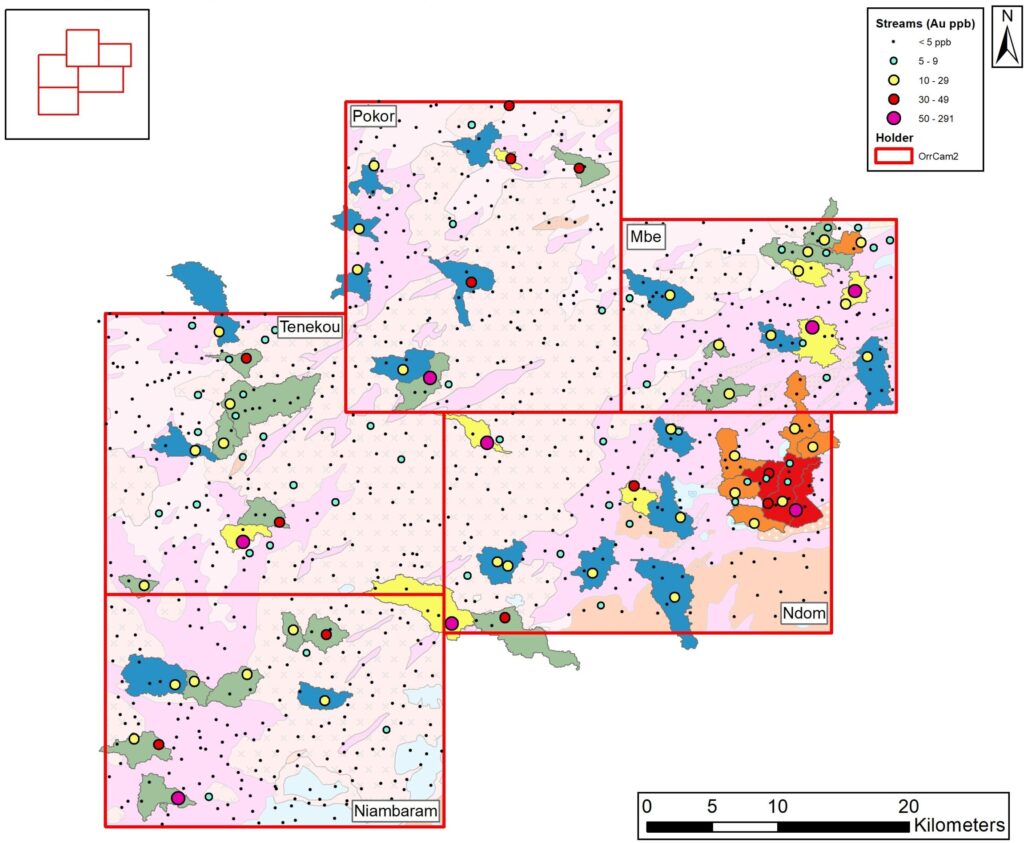
In Q3 2021, the Company completed regional mapping and stream sediment sampling over the Eastern CLP. The results identified multiple areas of elevated gold in distinct drainage basins, associated with the northeast-trending TBSZ corridor and related structures. Best results of 291 ppb Au and 95 ppb Au were returned from the Ndom and Tenekou licences respectively and a total of 18 areas graded >30 ppb Au. Follow-up semi-regional soil sampling (400m by 200m spacing) over six initial grids confirmed anomalous gold in all five Eastern CLP licences and has delineated multiple 2-3km long gold-in-soil anomalies across the Ndom, Pokor and Niambaram licences, as well as a broad zone of gold anomalism within the Mbe licence, where en-enchelon, structurally-controlled trends are now confirmed to occupy a c.12.5km long by 3km wide corridor. Best results included 838 ppb Au (0.84 g/t Au), 520 ppb Au and 463 ppb Au. Much of the follow-up gold-related exploration work at the CLP prioritised Mbe with further semi-regional scale infill stream and soil sampling programmes planned across many of the other kilometer scale gold-in-soil anomalies within the other CLP licences.
Ndom
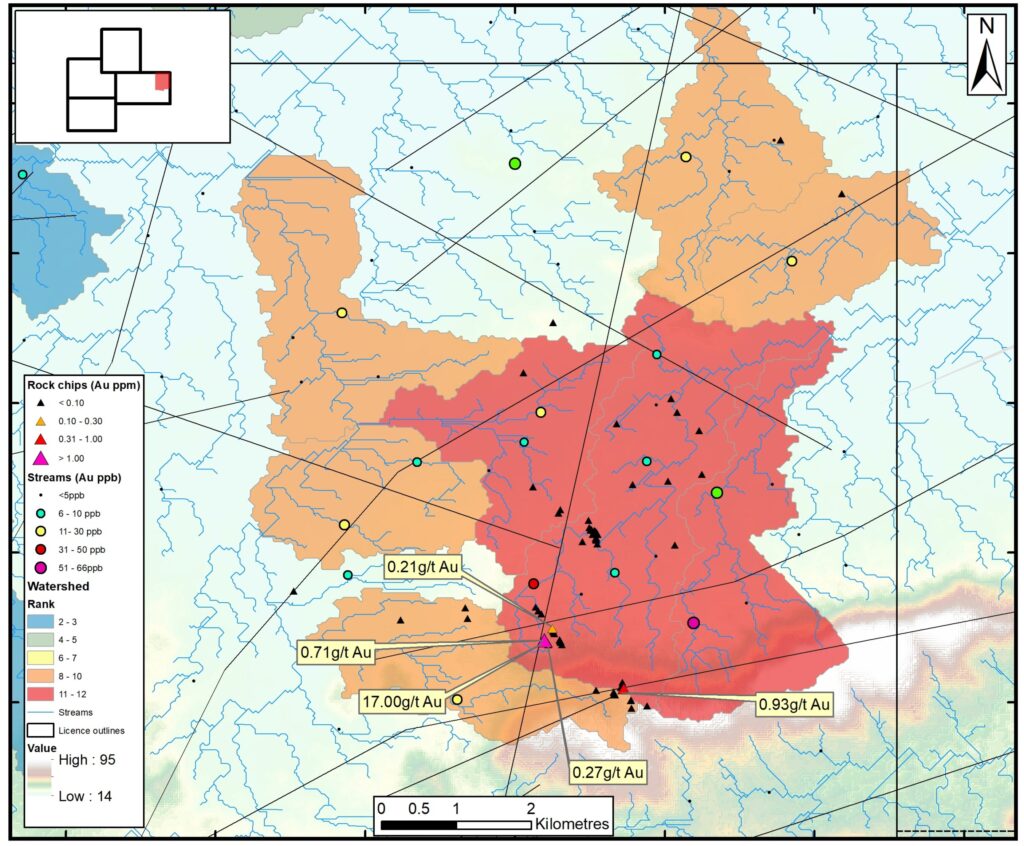
The results of the regional scale stream sampling programme identified gold-in-soil anomalism covering approximately 64km2 of contiguous watersheds in the eastern part of Ndom. However, the initial soil sampling over that area did not return significant gold anomalies compared to the results at Oriole’s adjacent Mbe licence. A reconnaissance visit of the area identified a thicker and more complex regolith cover than at Mbe, which may have masked the gold anomalism at surface, and thus this area required further investigation.
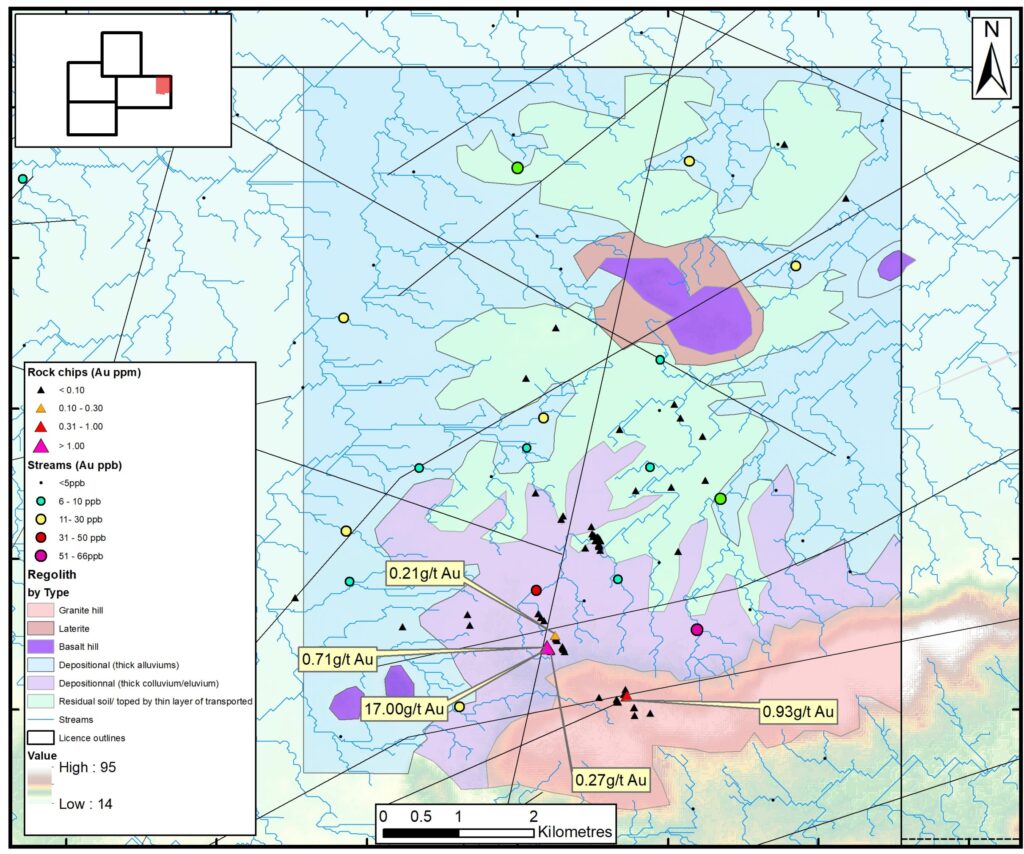
Alongside regolith mapping across two targets (ND01 and ND02), 96 selective rock-chip samples (including QAQC) were collected across the ND02. Rock-chip sampling typically targeted quartz veins and a tentative NW-SE trending control to the higher grading samples is interpreted, therefore similar to the controls on mineralisation observed at Mbe. Best results include 17.00g/t Au, 0.93g/t Au, and 0.71g/t Au and were returned from a 3km x 2km zone, located to the north of a NE-SW trending granite ridge, which has coincident gold-in-stream sediment anomalism.
Based on regolith mapping at ND01 identifying alluvial material, a follow-up work at ND01 is on-going that consists of a combined soil sampling (over in-situ material) and hand auger (over alluvial terrace material) sampling programme.
Pokor
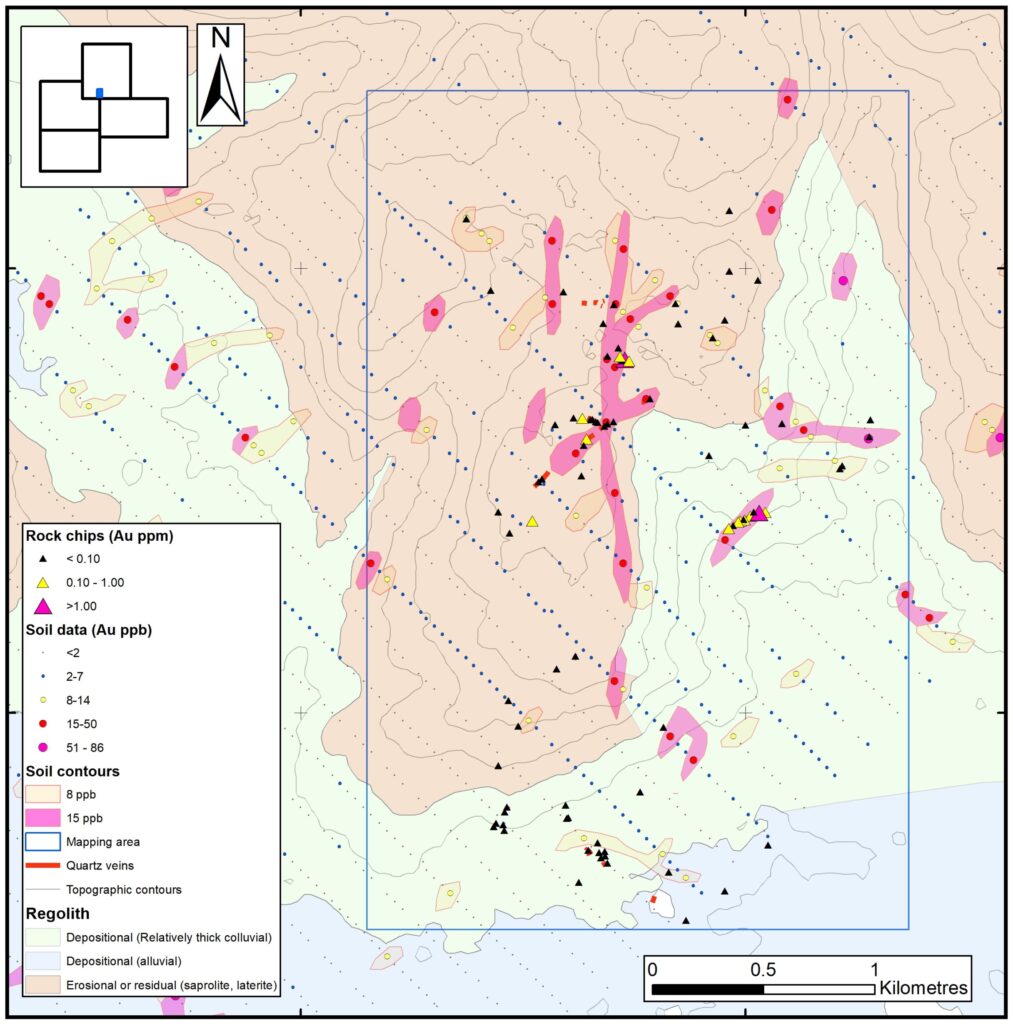
Following on from the regional exploration work, an initial infill soil sampling grid (PK01) focused on anomalies within the regional soil Grid 3, was completed in 2024. These results did not materially change the gold-in-soil anomaly targets within Grid 3 from 2022. In 2026 the team have completed regolith mapping at PK01 and geological mapping and rock chip sampling over an area of ~9km where gold-in-soil values up to 120ppb Au had been returned and an ~1km N-S trending gold-in-soil anomaly had been identified.
Geological mapping identified lithologies that are comparable to those identified at Mbe, including a basement orthogneiss unit that has been intruded by felsic dykes of granitic composition and later mafic dykes. Localised silicifation, brecciate quartz veins, and visible sulphide minerals are also observed in outcrop. Fourteen rock chip samples of those samples from PK01 returned Au grades >0.1g/t Au with higher grading samples associated with NNE- to NE- trending gold-in-soil anomalies that cross-cut the main N-S corridor.
In 2025, two soil sampling grids, PK02 and PK03, were completed at Pokor for 2,490 samples including QAQC. The Company acquired multi-elemental data on these samples using a pXRF and, based on the multi-element data and existing geological data, a prioritised batch of 1,154 samples (including QAQC) was selected for gold assay. The results did not return any obvious gold targets for follow-up, with best results of 35ppb and 26ppb Au and so the team re-focused its efforts on the anomalism already identified within the PK01 grid.
Niambaram
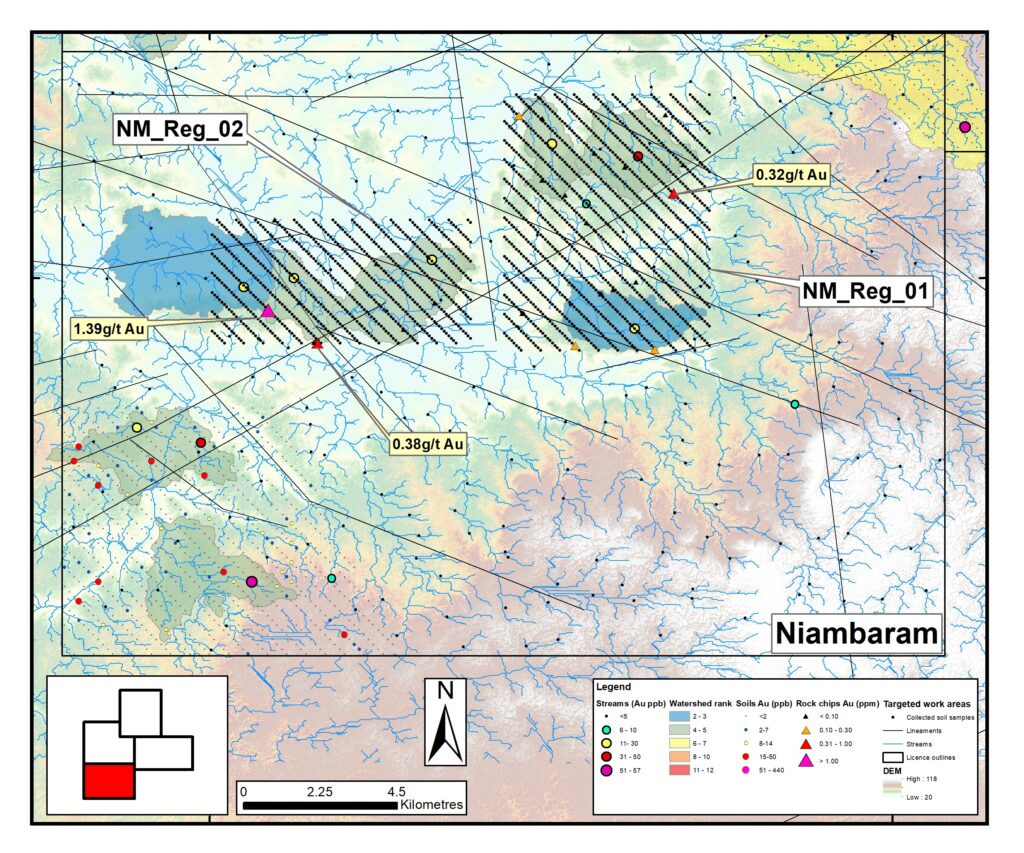
Two regional soil sampling grids (NM_Reg_01 and NM_Reg_02) were planned at 400 by 100m spacing targeting watersheds where anomalous gold-in-stream sediment results were identified in the northern half of the licence. Sampling was completed in H1 2026, preparation of the samples is ongoing and results are anticipated in H2-2026. Alongside the soil sampling programme, 34 rock chip samples (including QAQC) were collected over outcrops of interest, including quartz veins and strongly silicified felsic rocks with disseminated sulphides. Six samples graded ≥0.1g.t Au, with a best result of 1.39g/t Au.
Initial follow-up work at Niambaram is underway and consists of mapping and rock chip sampling at the southern edges of NM_Reg_01 and NM_Reg_02 soil grids, and over two areas in the southwest of the licence area (within Grid #4) where the regional soil sampling had returned up to 57ppb Au.
CLP – Lithium exploration
A review of stream and soil multi-element data has also identified the potential for lithium within the Ndom licence. Two lithium-in-soil anomalies trending east northeast, parallel to the regional shear, and extending up to c.9km in length were identified in the south-eastern Ndom licence area with lithium-in-soil values up to 84 ppm.
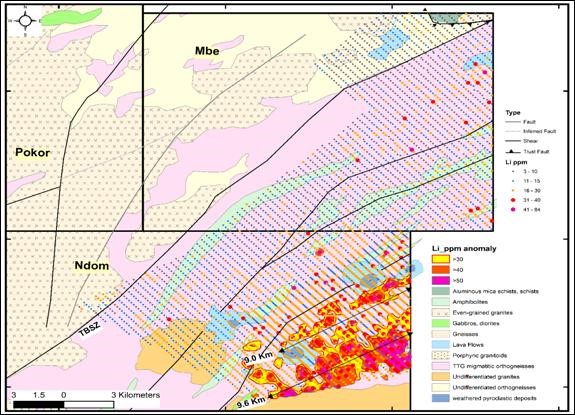
The southernmost anomalous trend overlies an east-northeast trending massive granitoid outcrop, confirmed to be highly fractionated and likely S-type granites (derived from sediments) known globally for their association with lithium deposits. Preliminary mapping of the Li-in-soil anomalies delineated the extent of the granitoid body and confirmed the presence of numerous pegmatite veins in granitoid outcrops, and within the Pan-African basement rocks (greenschist to amphibolite facies, tonalite- trondhjemite-granodiorite ‘TTG’), with widths ranging from a few centimetres to several metres.
While lithium bearing minerals have not been identified in the field, given abundance of white micas in some specimens, and the geochemistry to date, the presence of lithium bearing minerals (petalite, lepidolite) and cassiterite (tin-bearing mineral that commonly occurs in pegmatites) are suspected.