CLP – Other
The CLP is a district-scale land package in central Cameroon, covering ~3,600km2 of previously unexplored Paleo-Proterozoic to Pan-African age rocks that are highly prospective for a range of commodities, including orogenic-style gold mineralisation and lithium.
Located to the west of the regional capital, Ngaoundéré, the package comprises the Eastern CLP licences (Tenekou, Niambaram, Pokor, Ndom and Mbe), the Western CLP licences (Mana, Dogon and Sanga), both prospective for gold; Oriole has 90% ownership of seven of the licences, the exception being Mbe (where BCM International has earned 50% ownership, and administration is in progress for Company to purchase its local partners combined 10% equity position). A further licence, Maboum, is currently under application to the east of the Eastern CLP.
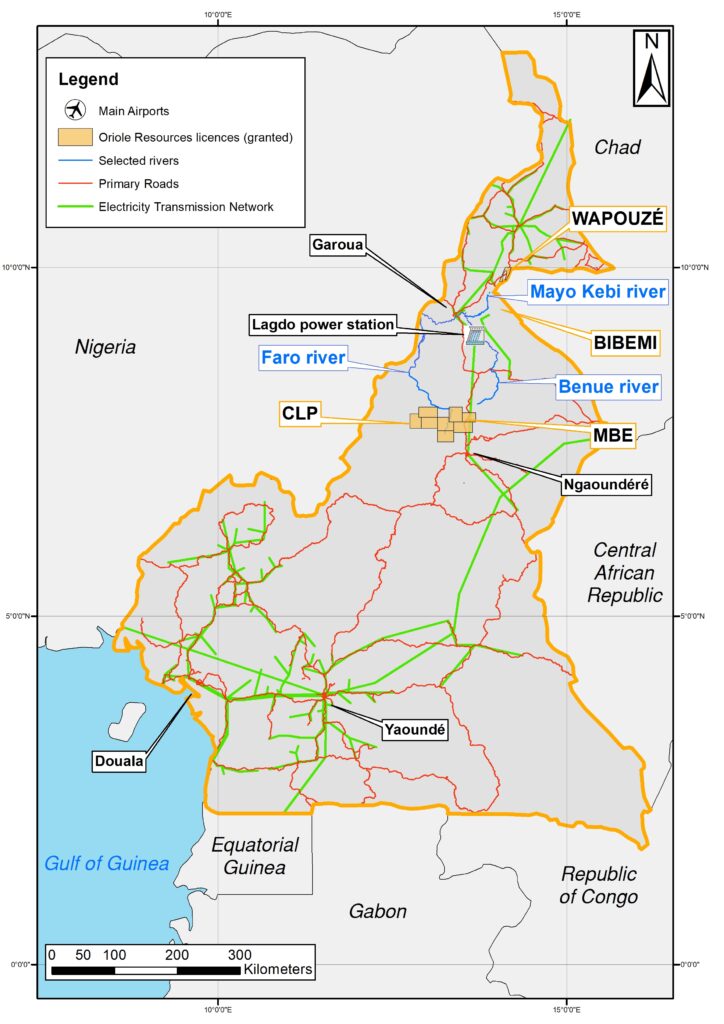
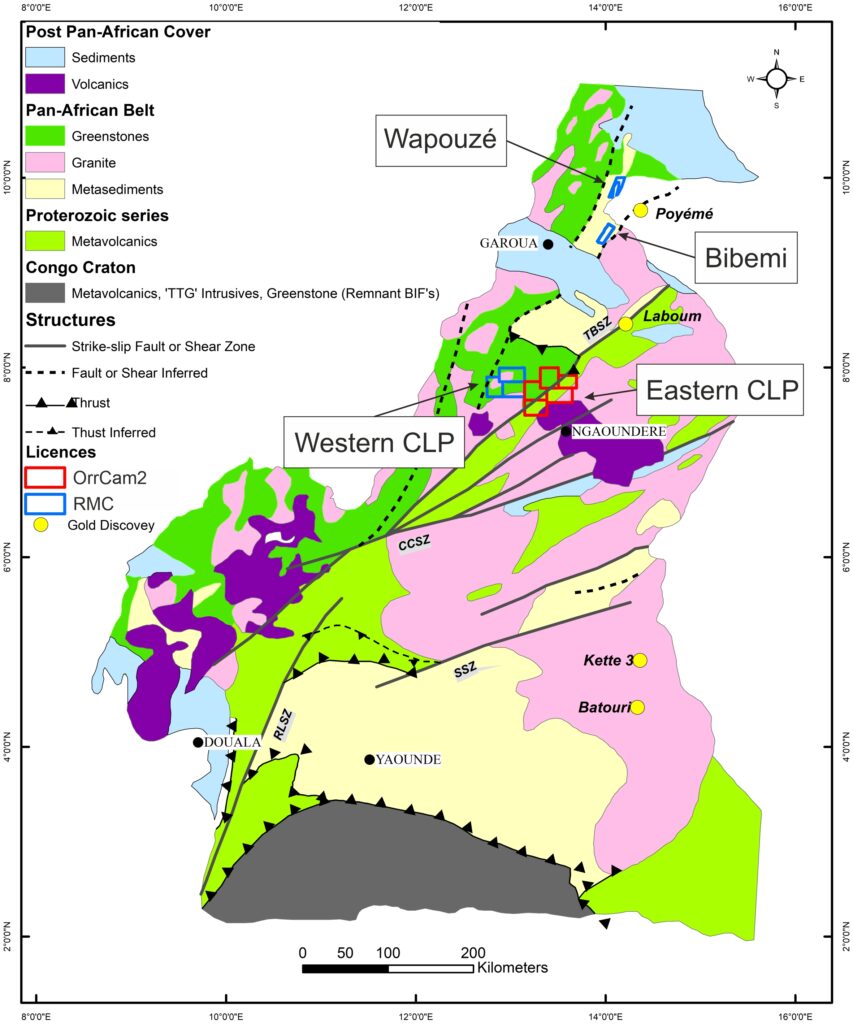
The eight Eastern CLP and Western CLP licences, all of which were granted in February 2021, were applied for following an in-house, country-wide prospectivity analysis that deemed the district as having significant potential to host orogenic-type gold mineralisation. This assessment was made on the basis of host-rock geology, structural location – targeting the regional Tcholliré-Banyo shear zone (TBSZ) which is a major splay off the larger scale Central African Shear Zone. The TBSZ and its associated shears, thrusts and faults are (according to academic literature) thought to be one of the significant structural controls for gold and other mineralisation in the region. Remote sensing work on the CLP has interpreted that the TBSZ passes through at least six licences; all of the Oriole licences in the east of the package and at least one of the BEIG3 licences (Sanga) in the west, with the potential for it to be hidden by the Cenozoic cover rocks in the Mana and Dogon.
Eastern CLP – Gold exploration
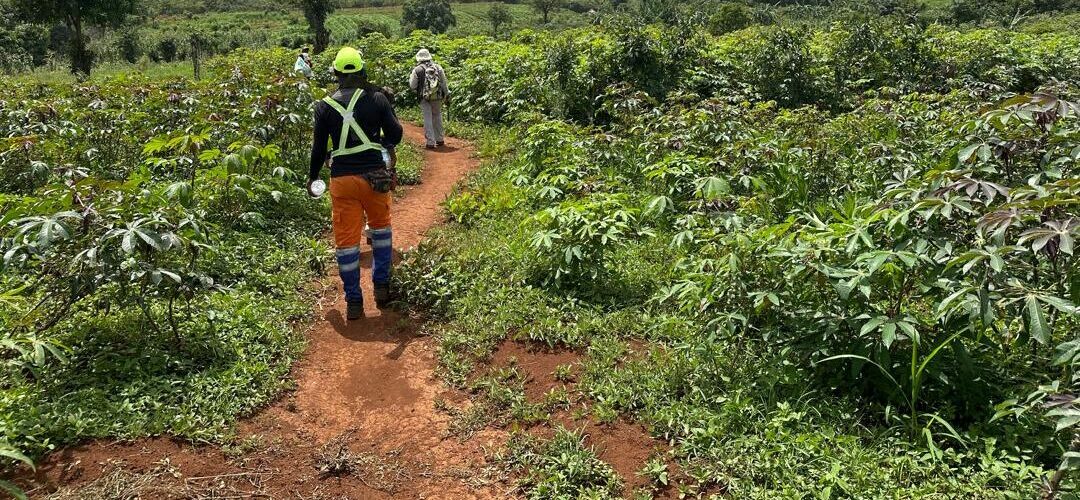
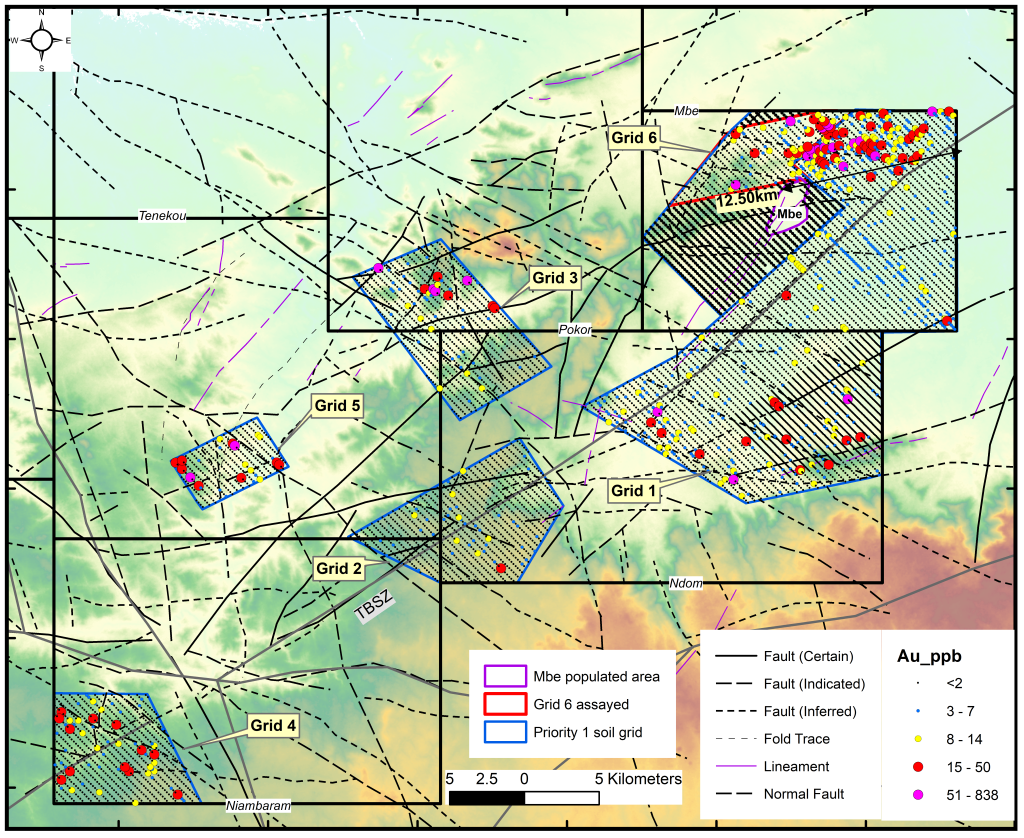
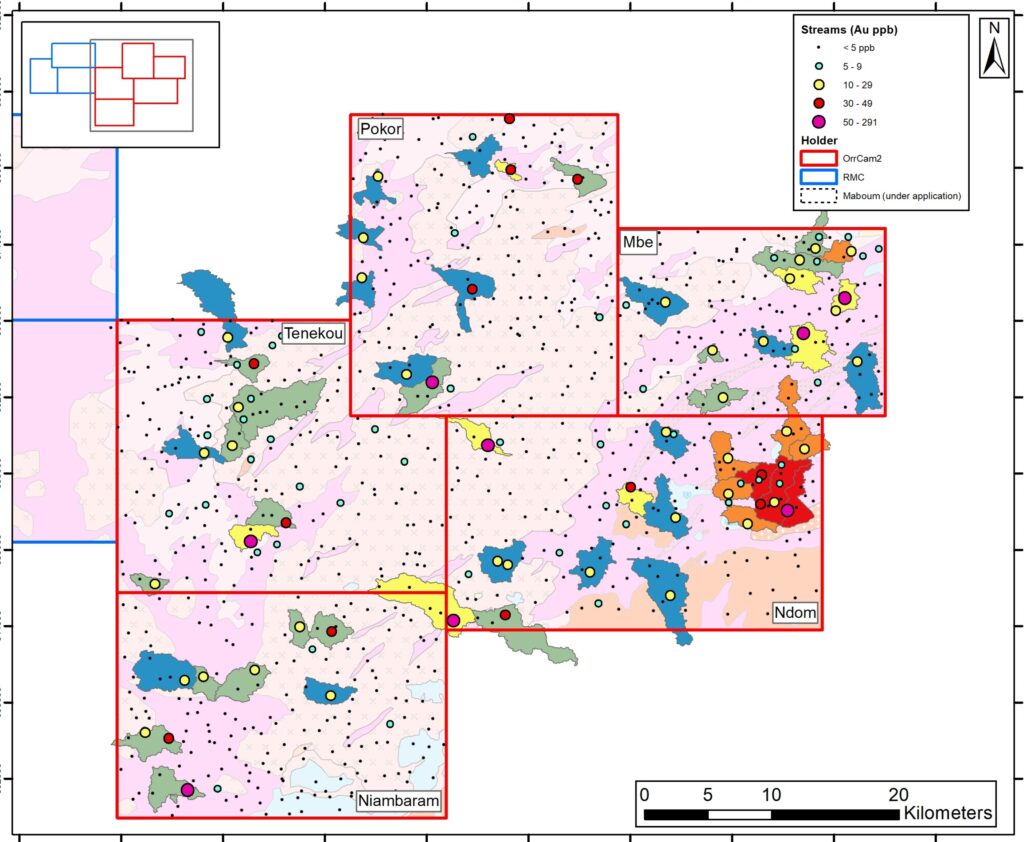
In Q3 2021, the Company completed regional mapping and stream sediment sampling over the Eastern CLP. The results identified multiple areas of elevated gold in distinct drainage basins, associated with the northeast-trending TBSZ corridor and related structures. Best results of 291 ppb Au and 95 ppb Au were returned from the Ndom and Tenekou licences respectively and a total of 18 areas graded >30 ppb Au. Follow-up semi-regional soil sampling (400m by 200m spacing) over six initial grids confirmed anomalous gold in all five Eastern CLP licences and has delineated multiple 2-3km long gold-in-soil anomalies across the Ndom, Pokor and Niambaram licences, as well as a broad zone of gold anomalism within the Mbe licence, where en-enchelon, structurally-controlled trends are now confirmed to occupy a c.12.5km long by 3km wide corridor. Best results included 838 ppb Au (0.84 g/t Au), 520 ppb Au and 463 ppb Au. Much of the follow-up gold-related exploration work at the CLP prioritised Mbe with further semi-regional scale infill stream and soil sampling programmes planned across many of the other kilometer scale gold-in-soil anomalies within the other CLP licences.
In 2024, a stream sampling programme was completed across the Gamboukou licence area with the samples analysed for gold at an internationally accredited laboratory and a suite of 43 elements using a portable XRF to investigate potential lithium pathfinders (see CLP – Other – Lithium exploration). Results of the gold values were combined with the Eastern CLP stream data to investigate the potential for gold at Gamboukou by applying a watershed ranking value, the same methodology employed for the Eastern CLP streams. This uses three factors (the amount of anomalous gold values within a watershed, the average of gold within any given watershed including all values, and the number of adjacent watersheds with anomalous gold) to define prospectivity of the area. Gold-in-stream values at Gamboukou were recorded up to 39 ppb and the watershed ranking system showed comparable rankings with those at Mbe providing target areas for follow-up work.
CLP – Lithium exploration
A review of stream and soil multi-element data has also identified the potential for lithium within the Ndom licence. Two lithium-in-soil anomalies trending east northeast, parallel to the regional shear, and extending up to c.9km in length were identified in the south-eastern Ndom licence area with lithium-in-soil values up to 84 ppm.
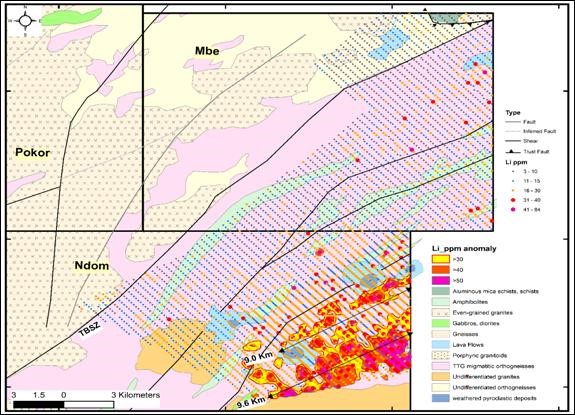
The southernmost anomalous trend overlies an east-northeast trending massive granitoid outcrop, confirmed to be highly fractionated and likely S-type granites (derived from sediments) known globally for their association with lithium deposits. Preliminary mapping of the Li-in-soil anomalies delineated the extent of the granitoid body and confirmed the presence of numerous pegmatite veins in granitoid outcrops, and within the Pan-African basement rocks (greenschist to amphibolite facies, tonalite- trondhjemite-granodiorite ‘TTG’), with widths ranging from a few centimetres to several metres.
While lithium bearing minerals have not been identified in the field, given abundance of white micas in some specimens, and the geochemistry to date, the presence of lithium bearing minerals (petalite, lepidolite) and cassiterite (tin-bearing mineral that commonly occurs in pegmatites) are suspected.
Western CLP
At the Western CLP, the structural control is interpreted to be dominantly north-northeast-south-southwest, associated with more recent (Cenozoic) bimodal volcanism that is believed to overlie the older Paleo-Proterozoic to Pan-African rocks and may represent a reactivation of older structures. Variably deformed orthogneiss units dominate the licence package, intercalated with amphibolite, quartzite and migmatite units and shearing and quartz vein development is parallel to the TBSZ, with the veins typically forming at the contact zones between the granite and amphibolite. Locally these units are cut by younger, basaltic rocks, supporting the interpretation for bimodal volcanism. In addition to the orogenic mineralisation being targeted within the licence package, this more recent volcanism highlights the potential for other styles of gold mineralisation (e.g. high-sulphidation), which may overprint the older system locally. Work is yet to commence at these licences.